“What we experienced was only a glimpse of what’s going on in those jails,” South African Global Sumud Flotilla Delegates Share Accounts of Abuse in Israeli Detention
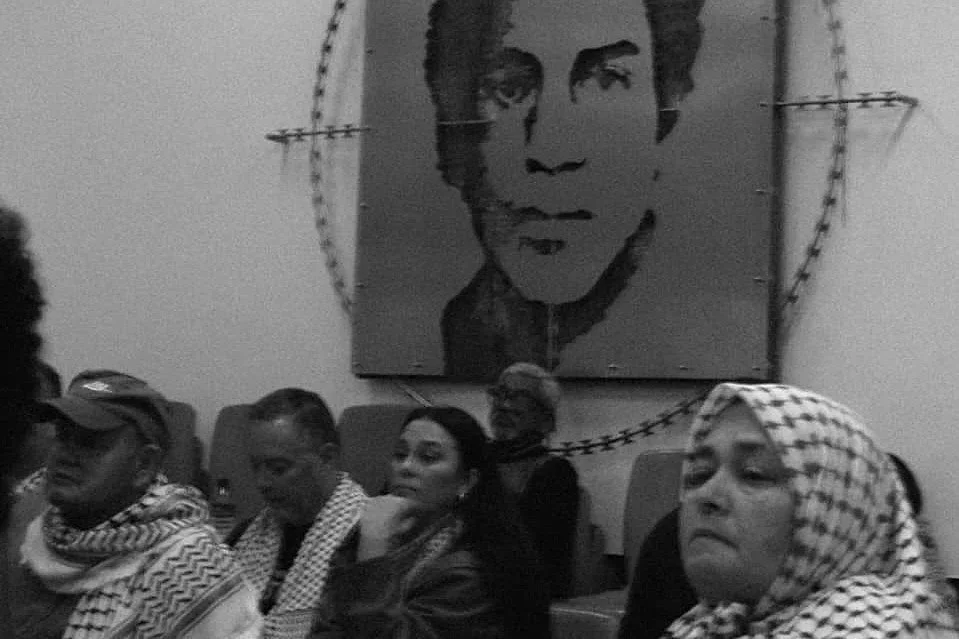
Image: Nurah Fisher
Content warning: discussion of abuse including sexual assault
Last month, five South African delegates from the Global Sumud Flotilla (GSF), which set sail for Gaza in May of this year, appeared at the Ashley Kriel Hall in Salt River to share the testimonies of their unlawful detention and persecution by the state of Israel. The five delegates, Faizel Moosa, Qutb Hendricks, Mogamed Faeek Ariefdien, Hajar Kagiso Al-Tha’irah Ahjum-Mathee, and Dr Fatima Hendricks were joined on stage by Palestinian artist Mai Shaer and a chairwoman from the Palestine Solidarity Campaign (PSC).
Four of the five delegates were dressed in matching grey tracksuits. “This is the very outfit that they gave us in prison,” shared Moosa. “Ktzi’ot. The worst of the prisons in Palestine, where they torture our Palestinians. This is their logo,” he said as he pointed to the prison’s emblem below his left shoulder. Following their release, the delegates have printed FREE PALESTINE below the prison’s logo and a motif of the Sumud Flotilla on the back, featuring a silhouette of a person holding up a vibrant Palestinian flag.
The GSF consisted of over 70 vessels carrying more than 3000 participants from 100 countries, the PSC chairwoman who commenced the panel shared. She further stated that their mission was to deliver emergency aid, including food and medical supplies, and also to transport international teams of doctors, nurses, eco-builders, and human rights investigators to Gaza. Their efforts were devoted to providing humanitarian relief and to documenting the unspeakable human rights violations perpetrated against Palestinians, said PSC chairwoman. Upon their approach to Palestinian shores, the Flotilla activists were illegally intercepted in international waters by Israeli naval occupying forces. The activists were then detained and subjected to unlawful brutal force and torture.
The PSC chairwoman offered a statement regarding the campaign’s creed, stating that, “We stand against the apartheid and Zionist policies of Israel. We stand against Zionism. Not against Jews or Judaism.” In recognition of the event, the South African Jews for a Free Palestine, a Jewish, South African organisation advocating for Palestinian freedom, had also been in attendance. The panel also emphasised the role of economy in the subjugation of Palestinians and stated that they “condemn all states, corporations, companies and individuals who are complicit in the genocide of Palestinians, through their political, economic, and cultural support of the illegitimate Israeli occupiers.” The PSC would also share that they routinely faced continued onslaughts on their solidarity activities, particularly by Zionist forces intent on sowing division.
Faizel Moosa, a humanitarian political activist and veteran of the anti-apartheid struggle, opened his testimony and stated adamantly that “there is no place for a two-state solution,” a declaration subsequently met with applause. He shared that the delegates were unlawfully held hostage by the state of Israel for four and a half days, and in that time he realised the impossibility of a two-state solution governed by Zionist ideology. Moosa further added that they had “a little peek at what Palestinians have to go through every day.” Including the 9800 still behind bars, of which 400 are children. That peek, he elaborated, involved near-constant physical abuse, degradation, humiliation and pain, from the moment of interception until they were no longer held hostage.
He then detailed his first encounter with the Israeli Defence Forces (IDF) and painted a picture of their unimaginable cruelty and inhumanity. He noted that before diplomatic talks could take place, the IDF fired rounds of rubber bullets at the vessels, one of which collided with Moosa’s shoulder. Following this, he revealed that upon interception, the delegates were cable-tied. The improper restraints soon caused Moosa to lose feeling in his fingertips and his wrists to bleed. The IDF then strongarmed the delegates into stress positions for multiple hours to maintain control over their unlawful capture and seizure of the delegates. Positional torture, or more commonly referred to as ‘stress positions,’ refers to any type of torture where a victim is forced to remain in a fixed position for an extended period of time, says the Danish Institute Against Torture. Mogamed Faeek Ariefdien noted that irrespective of age or gender, the delegates would be expected to maintain these stress poses for two to three hours at a time.
The United Nations Convention against Torture and Other Cruel, Inhuman or Degrading Treatment or Punishment, is an international human rights treaty which mandates a global prohibition on torture. The Convention also recognises that any act which causes severe pain or suffering, physical, mental or otherwise, is consistent with the definition of torture. “On our ship, we had 35 broken ribs and fractured chests. We had 15 sexual assaults. We had quite a few people who were tazed. One comrade was so badly tazed that you couldn’t see the skin on his back. We had broken ankles. Broken wrists. Dislocated shoulders and much more,” said Ariefdien, describing the brutal assaults which they had faced.
“I lifted myself up because I couldn’t take the pain anymore. And then a knee came down on my neck, to force my head back onto the ground,” Moosa confessed. Moosa, along with Hendricks, surmised that the average age of the IDF soldiers was 22 to 24 years of age. “Children,” 62-year-old Moosa commented, and the room fell silent. He took time during his testimony to mention the atrocities committed in Sudan, the Democratic Republic of Congo and in Lebanon, and how the struggle for freedom is not only connected but intersectional. Moosa highlighted the importance of the Boycott, Divestment and Sanctions (BDS) movement as well, problematising South Africa’s exportation of coal to Israel, arguing that the South African government is complicit in fuelling the oppressive, Zionist regime as well as the human rights abuses faced by humanitarian workers like the GSF delegates. In closing, he addressed South Africans and declared that “we better wake up and smell the coffee because every day, I see them taking the steps to implement and make the Western Cape a Zionist enclave.”
Applause filled the Ashley Kriel hall in the Community House as Qutub Hendricks received the microphone from Moosa. He began his testimony by reading words written on the wall in his jail cell. “I am 34 years old from Khan Younis. And I am in jail now for 8 years. Dated December 2024. Hasbunallahu wa ni’mal wakeel. God is sufficient for us, and He is the best disposer of affairs.’” He revealed that from 70km away, that was the only connection he could make with “our fellow brothers and sisters in Palestine,” as Palestinian prisoners were moved from their cells to make room for the GSF delegates. “We felt their presence. We felt their pain. We felt their sorrow,” Hendricks mourned.
The Dullah Omar Institute upholds that under the UN Convention against Torture, no person may be subjected to torture and ill-treatment under any circumstance, including during times of war. This, however, would not be the case for Hendricks. “‘Bliksem hom! Bliksem hom! Bliksem hom!’ I heard these words in the Ktzi’ot jail. These words echoed as I was physically abused. Tortured. Sexually abused. By three doctors. Female doctors. I was broken. I was mentally abused. Physically drained. But that evening, I had a moment of Sumud. A moment of steadfastness.”
These gut-wrenching revelations would continue as Hendricks detailed a visit to the prison by Israeli minister of national security, Itamar Ben-Gvir. “He pointed to me, and he said, ‘You! Stand up!’ And as broken as I was. Drained as I was, because I had just been electrocuted two hours prior, I stood up. You know why?” He asked the crowd. “Because we are South African! We are resilient people!” he declared, to which the crowd offered an exuberant applause. “Our Palestinian brothers and sisters are going through that torture on a daily basis. What we experienced was only but an iota, only but a glimpse of what’s going on in those jails,” Hendricks said.
According to Hendricks, Ktzi’ot prison features a rudimentary, prefab structure known as the courtroom. At the helm of the room is a “so-called” judge, said Hendricks. The judge announced Hendricks’ charges and told him that he had been illegally sailing on their waters. Hendricks responded with, “But we were in international waters.” The judge adamantly offered a decree, saying, “No! All the sea belongs to us!”
When questioned by the judge about his reason for being in Palestine, Hendricks firmly said, “I am a chef! By profession. And I wanted to go to Gaza, to cook for our beloved Gazan brothers and sisters!” Hendricks stated that the judge fired back and said, “They are all going to die anyway. So what’s the point? From the baby to the adults, they are all Hamas terrorists. Like you! It’s been written, they will die, very soon.”
Hendricks’ testimony further detailed their unimaginably gruesome release, “As we left the prison, they wanted to leave us with a big ‘thank you.’ And they wanted to leave us with a few images. So, in the courtyard, there were pictures of the bombed Gaza Strip. And it was written proudly in Arabic, This is the new Gaza. Babies killed. Pictures of raped women. Pictures of limbs missing from the bodies of our beloved brothers and sisters. Those were the images that they wanted to leave us with,” His voice began to break. Hendricks corroborated the statements made by Ariefdien, confirming the violence sustained by the delegates from IDF soldiers: “It’s the first time that I’ve been on a flight where my colleagues and comrades were lying on the floor because they couldn’t sit from the broken ribs, and the broken ankles that they had.” In closing, he stated that as South Africans, “We are a people united. We are a people of conscience. And we are now rising up. We are rising up and we will win this fight. Palestine will be free!”
Despite having had to relive the inhumane treatment dolled out by IDF soldiers, Mogamed Faeek Ariefdien opened his testimony by describing himself as “fortunate enough” to have made the humanitarian mission to Palestine, as part of the GSF. The fortune, however, would be marred by unforgettable humiliation. “On three different occasions I had to strip naked. Take all my clothes off. And then I had to turn around, bend over and squat. They thought I had a phone hidden somewhere.” Ariefdien further stated that once naked, “you had to turn around, and they would laugh and make jokes,” in plain view of everyone else onboard. He said that “after going through all of this, only one thing comes to mind; there cannot be a two-state solution. It’s impossible.”
Ariefdien revealed that due to being kidnapped and held prisoner, the delegates could not personally deliver the aid to Gaza as they had intended to do. He stated retrospectively, however, that some aid had fortunately washed up on the shores of Gaza after being abandoned by the IDF soldiers on the vessels. He shared that a possibility of failure soon faded upon arriving in Türkiye, as the delegates had received a message from the Palestinians which said, “Your mission is a success! The minute you set sail, your mission is already a success.” “He listed other successes of the mission; one being when the delegates set foot “on the holy lands of Palestine” as well as getting taken to the “concentration camp” and being close enough to where Palestinians could hear not only their torture, but the dedication to Palestinian liberation in their cries. “The pain that we endured was sharing their pain. So, that was another success for us,” he confessed. “They made our resolve stronger.” he added.
Ariefdien, in closing, stated, “We are preparing for the next flotilla!” and he urged young people to take up the mantle and visit the Global Sumud Flotilla portal online to register and to declare their intentions of making the humanitarian journey to Palestine. Applause filled the room as he took his seat and Hendricks began to chant. “Hajar! Hajar! Hajar!” as Hajar Kagiso Al-Tha’irah Ahjum-Mathee rose to share her testimony. Fond smiles appeared on the faces of her fellow delegates, as 22-year-old “firebrand” Hajar, the “fire from the hip” as nicknamed by Moosa, received the microphone. “We survived the experience in different ways, and my survival relied on me mostly dissociating from what happened,” she remarked solemnly.
Ahjum-Mathee shared that due to the non-violent objectives of the humanitarian mission, the delegates ensured that all items on the boat could not be misinterpreted as weapons. She recalled that in the past, a 19-year-old humanitarian worker had been filming his interception on his cell phone, and as a result, had been shot and killed by the IDF. It is for this reason that the delegates on the GSF discarded their phones into the sea upon interception, as well as taking extra care in ensuring not to stock sharp knives on the boat. “We carry butter knives. And so, trying to slice through bread and rolls with a butter knife is very annoying, I can tell you that! She said with a hearty smile. Her testimony earmarked fond memories of moments with her fellow delegates, as well as moments of frustration at being labelled a terrorist, despite being an international humanitarian aid volunteer.
Ahjum-Mathee reflected on the journey and noted that, “we keep three Palestinian principles in our head; of sumud, steadfastness; resilience; and sabr, patience. And you keep Palestine in your head. And that is the one thing that can keep you going through every violation that they show you, through every violation in prison itself.” She left the crowd with a parting remark: “united we cannot be defeated.”
Ahjum-Mathee handed over to occupational therapist, Dr Fatima Hendricks, who began her testimony by remarking on the significance of the panel being held at Ashley Kriel Hall. She drew attention to the poignant murder of Ashley Kriel on July 9th, 1987. Ashley James Kriel, who was 20 years old at the time of his death, was an anti-apartheid activist who had been maliciously targeted by the apartheid Security Police for his activism. At 18, he joined Umkhonto we Sizwe (MK), the armed wing of the ANC. Kriel, operating in secrecy as an enemy of the state, was eventually detained by police and died following a “scuffle” during his arrest. An independent forensic investigator determined that his wounds were consistent with homicide; however, those complicit in his death were granted amnesty by the apartheid government.
Dr Hendricks stated that “the struggle for liberation in South Africa has given many martyrs,” as she reflected on the murder of Kriel. “It is the young who have worked intergenerationally for freedom, for liberation, in this country. And we remember our young martyrs in Palestine!” she continued. Dr Hendricks offered another rallying statement: “Around the world there are forces that seek to oppress the free peoples of the world because of greed. Insatiable lust for the resources and land that does not belong to them!” which was received by enthusiastic applause. “We need to understand the roots of the empire and the imperial project! And its foundations in settler colonialism!” she declared in closing.
Dr Hendricks opened the floor to Palestinian artist Mai Shaer. Shaer, born in Khan Younis and raised in Rafah, was forced to flee Gaza due to Israel’s genocidal onslaughts on Palestine. Although not part of the humanitarian mission herself, Shaer describes how she was incredibly moved by the political mobilisation and support from the international community towards Palestinians. She described wanting other people to share in the experience of reaching Palestinian soil, seeing the land and its people. Mai Shaer also emphasises that the mere idea of making the journey to Palestine in pursuit of solidarity is a powerful statement within itself. She stated further that despite the war, she misses her Gaza and her people, and yearns to make her return.
“We used to hear these stories when any prisoner was released. We all sat together and listened to them speaking, trying to imagine how bad it is. She continued her testimony with, “It’s just hard. There’s no other way to explain it. And we try to speak in a way where we don’t remind ourselves about the reality.” Shaer urged attendees not to forget that Palestinians “have been experiencing over 960 days of genocide since October 7th. More than 72000 people killed.” “And these are not the real numbers,” she cautioned, “there are missing people. We cannot forget them and only consider them as numbers.”
In her testimony, Shaer also reflected on the increasing Israeli encroachment on Palestinian land and shared that, “recently in Gaza, Israel decided to move the yellow line and expand their control over more than 70% of Gaza.” She mentioned that Gaza is “really small; it’s not a big country. Every time they do that, they displace more people. They keep bombing and destroying property. They are still bombing, and there are still people being murdered.”
Shaer offered advice on how people can advocate for Palestine: “Keep speaking about Palestine. Don’t stop speaking. Keep it in your conversations. At your dinner table. Amongst your friends. In your work. Keep speaking about Palestine, because this is what makes them feel that there’s someone who remembers them. Even if it didn’t change inside Gaza, they need to know that there are other people who know their suffering,” she pleaded. As her testimony closed, Shaer was met with applause and chants of “From the river to the sea! Palestine will be free!”
The testimonies closed with a brief comment from the PSC chairwoman before the floor was opened for questions. She thanked the delegates by saying that “their witness has once again re-energised our solidarity spaces and it has re-energised us to get organised.” She continued by saying that “strength comes from unity in action. And unity in action can only be achieved through organising at grassroots levels.” She added that “this is the challenge we must rise to, in building and strengthening our Palestine Solidarity Campaign. Just like the youth of 1976 made this country ungovernable, so too we must call upon today’s youth to galvanise this struggle.”
Maryam Abbas, a 19-year-old Yale University student who attended the panel, stated that “risk is extremely critical to the movement.” As tensions between South African and American governments continue to rise due to opposing views on Palestinian sovereignty, the 19-year-old exchange student noted that “it’s a lot easier to say free Palestine or wear a Keffiyeh over here.” She elaborated further and said that “every single system in America is deeply implicated with Zionism, with Israel. It’s not the United States of America, it’s the United States of Israel.”
In keeping with the ethos of the delegates, she also said, “I feel connected to Palestine simply because I am human.” About the broad mobilisation for Palestinian liberation in Cape Town, Abbas shared that she has “felt so much joy recently seeing how much work and solidarity there is in South Africa. There are people from all over the world who are looking at you and who feel so much inspiration.”
Despite having faced an unending list of human rights violations and unconscionable brutality by the IDF, the GSF delegates collectively share in the regret of leaving behind the besieged Palestinians and, as a result, are all eager to make the humanitarian voyage again.