How Art Versatile Africa is Preserving South African Culture Through Contemporary Art
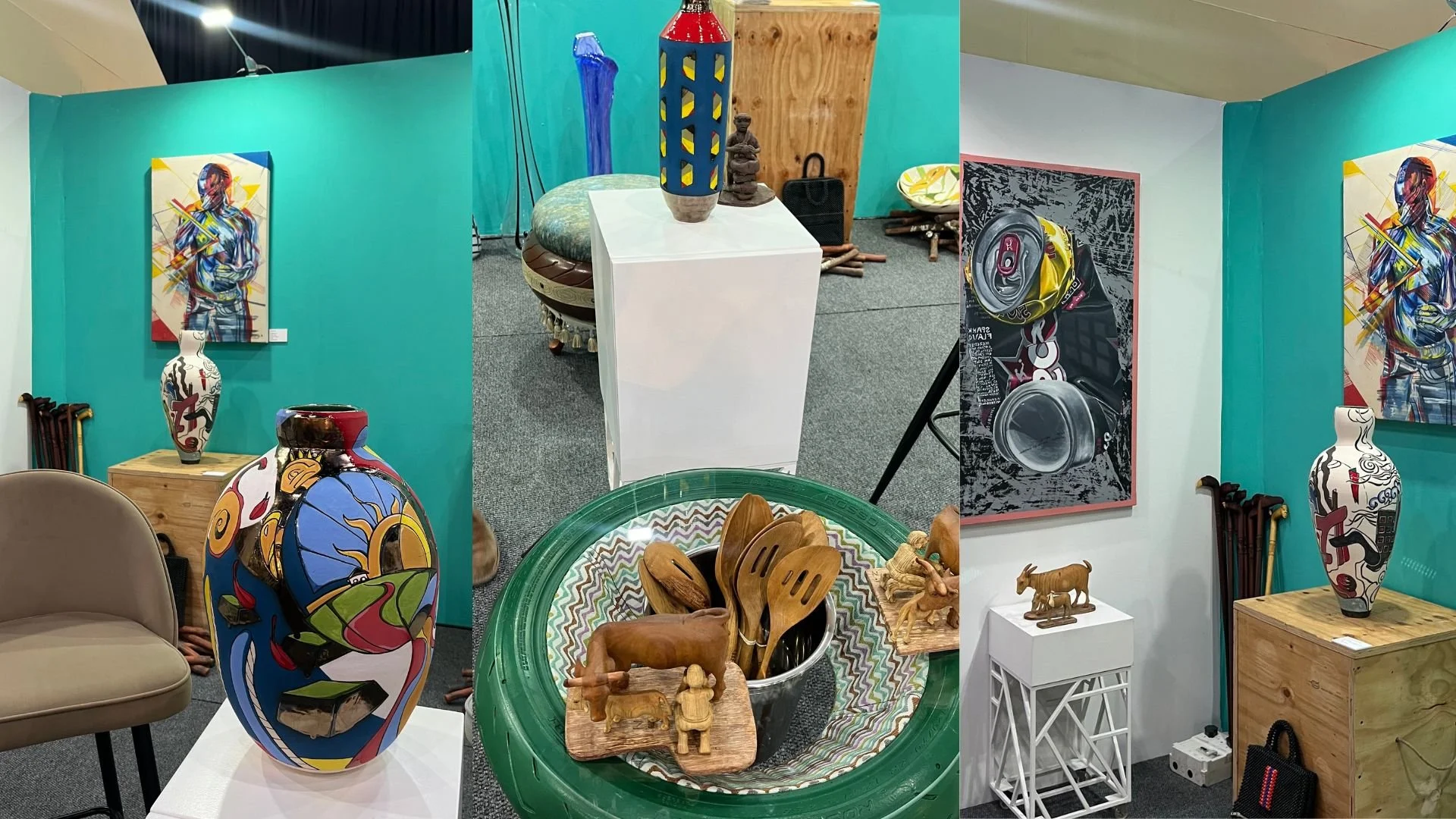
Image: Kgomotso Tsotetsi
There is something quietly radical about finding a contemporary art gallery at a design exhibition.
At an exhibition dominated by conversations about interiors, furniture and architecture, one stand at Decorex Africa invited visitors to pause for a different reason.
Art Versatile Africa filled its space with contemporary oil paintings, carved wooden sculptures, ceramics and handcrafted works that reflected African identity and cultural heritage. Rather than presenting art as decoration, the gallery presented it as a living record of history, memory and storytelling.
The exhibition prompted questions that extended beyond aesthetics. What role do galleries play in preserving culture? How do they support artists? And how can contemporary art keep traditions alive in a rapidly changing world? Those questions formed the basis of my conversation with Art Versatile Africa founder, CEO and Creative Director Litha Ncokazi.
“We’ve taken quite a bold step by exhibiting this body of work here,” he said.
Surrounded by paintings, sculptures and ceramics, Ncokazi explained that Art Versatile Africa sees itself as more than a commercial gallery. “For us, Art Versatile Africa is an African institution.” He described the gallery as a space grounded in entrepreneurship, innovation and indigenous knowledge systems. Its purpose, he said, is to create opportunities for artists to explore their identities while remaining rooted in their cultural traditions.
“We value practices informed by deep knowledge,” he said. “Our intention is to allow artists to delve into their own essence.”
That philosophy shapes every exhibition the gallery presents. Rather than focusing solely on commercial success, Art Versatile Africa encourages artists to produce work that reflects who they are and where they come from. Ncokazi believes galleries remain essential cultural institutions because they do far more than exhibit artworks.
“They facilitate market entry,” he said. “Not only for emerging artists but also for established practitioners.” He said artists need mentorship, professional guidance, management strategies and access to markets throughout their careers. “Artists need support.”
As a practising artist himself, Ncokazi understands those challenges firsthand. His experience informs the gallery’s curatorial approach, which places as much emphasis on nurturing artists as it does on showcasing their work. Many of the artists represented by Art Versatile Africa come from the Eastern Cape, particularly the OR Tambo District Municipality and Buffalo City Metropolitan Municipality. Bringing their work to Decorex Africa gives them access to audiences beyond their local communities. “It’s not just a national exhibition,” Ncokazi said. “This is an international platform.”
The exhibition demonstrates that African art belongs not only in museums or historical collections but also in contemporary spaces, where it can continue to evolve while remaining connected to its cultural roots. During our conversation, Ncokazi turned the discussion around and asked what the exhibition had awakened in me.
I told him I see myself as someone committed to preserving cultural history.
“I don’t want the history of any culture, especially our own, to disappear,” I said. “Fifty years from now, there should still be a record of who we were.”
His response was immediate. “Exactly. One has to fill that gap.”
That exchange captured the gallery’s broader mission. Art Versatile Africa is preserving more than artworks. It is preserving memory. Our conversation also touched on the richness of isiXhosa culture and the importance of documenting stories through visual art. “I think isiXhosa culture has so much essence,” I said. “It is incredibly rich in storytelling.”
Art, we agreed, offers one of the most powerful ways to carry those stories into the future while allowing traditions to evolve through contemporary creative practice. “We need more platforms like yours,” I told Ncokazi. “Not only in South Africa, but globally.” Since establishing Art Versatile Africa in 2018, Ncokazi has built partnerships with institutions that have expanded opportunities for the artists represented by the gallery. Future exhibitions and collaborations remain central to the gallery’s long-term vision.
Before I left, our conversation took an unexpected turn. After learning that I am studying curatorial practice at the University of Pretoria, Ncokazi invited me to develop a concept note for one of the gallery’s future exhibition ideas. It was a reminder that meaningful conversations often create opportunities neither party expects.
Leaving the Art Versatile Africa stand, I realised that what had initially attracted me was never simply the artwork itself. It was the intention behind it. In a cultural landscape increasingly shaped by speed, consumption and constant novelty, Art Versatile Africa asks visitors to slow down. It creates space to remember, to preserve and to ensure that African stories remain visible for future generations, because perhaps the greatest role of a gallery is not selling art at all. Perhaps it is ensuring that generations yet to come will know who we were through the stories painted onto canvas, carved into wood and fired into clay.
Art Versatile Africa is making that room. One exhibition at a time.