
Content warning: discussion of abuse including sexual assault and child pornography
"I was in those groups for three years, from 13 to 16. I had to mutilate my body for them, spread my blood on floors and walls and write satanic symbols. It's not only child pornography, it's more just sadistic people looking for someone to torture," says one survivor of digital terrorist network 764.
Testimonies such as these are rapidly populating online forums, telling of the gruesome tactics employed in online, nihilism forums. This particular survivor shared that they are in the process of ‘recovering and working with the police’ to find their main abusers. Recovery and justice, however, remain elusive for countless victims caught in the perilous, international web of 764, currently taking root in South Africa.
On August 7th, a 16-year-old Malmesbury teen was arrested for allegedly accessing and downloading child sexual abuse material (CSAM), with several child victims having been identified thus far. While apprehending the teen, South African Police Service (SAPS), alongside various international law enforcement agencies such as the Federal Bureau of Investigation (FBI), the United States Embassy, and the National Centre for Missing and Exploited Children (NCMEC), uncovered chilling evidence. The discovery included explicit images and videos depicting child sexual abuse and animal abuse on his devices during a preliminary search. During the investigation, there was an indication that the teen was linked to the international child exploitation network, 764. Police have also stated that additional allegations of fraud and money laundering form part of the ongoing investigation, with the teen now facing a total of 15 criminal charges.
The arrest of a 16-year-old boy on October 13 2026, for the stabbing of a 6-year-old girl in Umhlali, Ballito, KwaZulu-Natal, also has identifiable links to the cybercriminal syndicate, 764. The attack left the girl with three severe stab wounds, resulting in her hospitalisation. Armed with a knife and a homemade gun, the boy entered his old primary school dressed in a shirt paying homage to the perpetrator of a school shooting in Colorado, USA. Reportedly, the boy belonged to an online subculture called True Crime Community (TCC), known for idolising serial killers and for being connected to The Com and 764.
The illicit coalition, 764, first shattered the realities of many in late 2020. In Stephenville, Texas, 15-year-old Bradley Cadenhead was charged with the sexual grooming of a child, creating and distributing CSAM, and with cruelty toward animals. It was reported that Cadenhead named the group after the first three digits of his postal code. The convicted teen is currently serving an 80-year sentence in a Texas-state prison. Ryan Maxwell, Assistant Special Agent for the FBI, heading-up the counterterrorism program, describes 764 as a violent, online, gore group made-up of actors who seek to manipulate children into committing unspeakable acts against themselves, animals, and other children, including suicide.
Maxwell adds that these individuals will coerce victims into sharing personal information, explicit pictures and videos of themselves, for the purposes of blackmail and to force their prey into cycles of escalating manipulation. Defining goals of the group include the incitement of violence for the disruption of social cohesion, gaining notoriety through mass terrorism, extortion and the targeting of vulnerable members of society. The 764 network is part of a loosely connected, transnational set of online groups called The Com, and it engages in the sextortion (sexual extortion) of minors who are often forced to produce CSAM, which is then used as leverage to strongarm victims into performing other criminal acts.
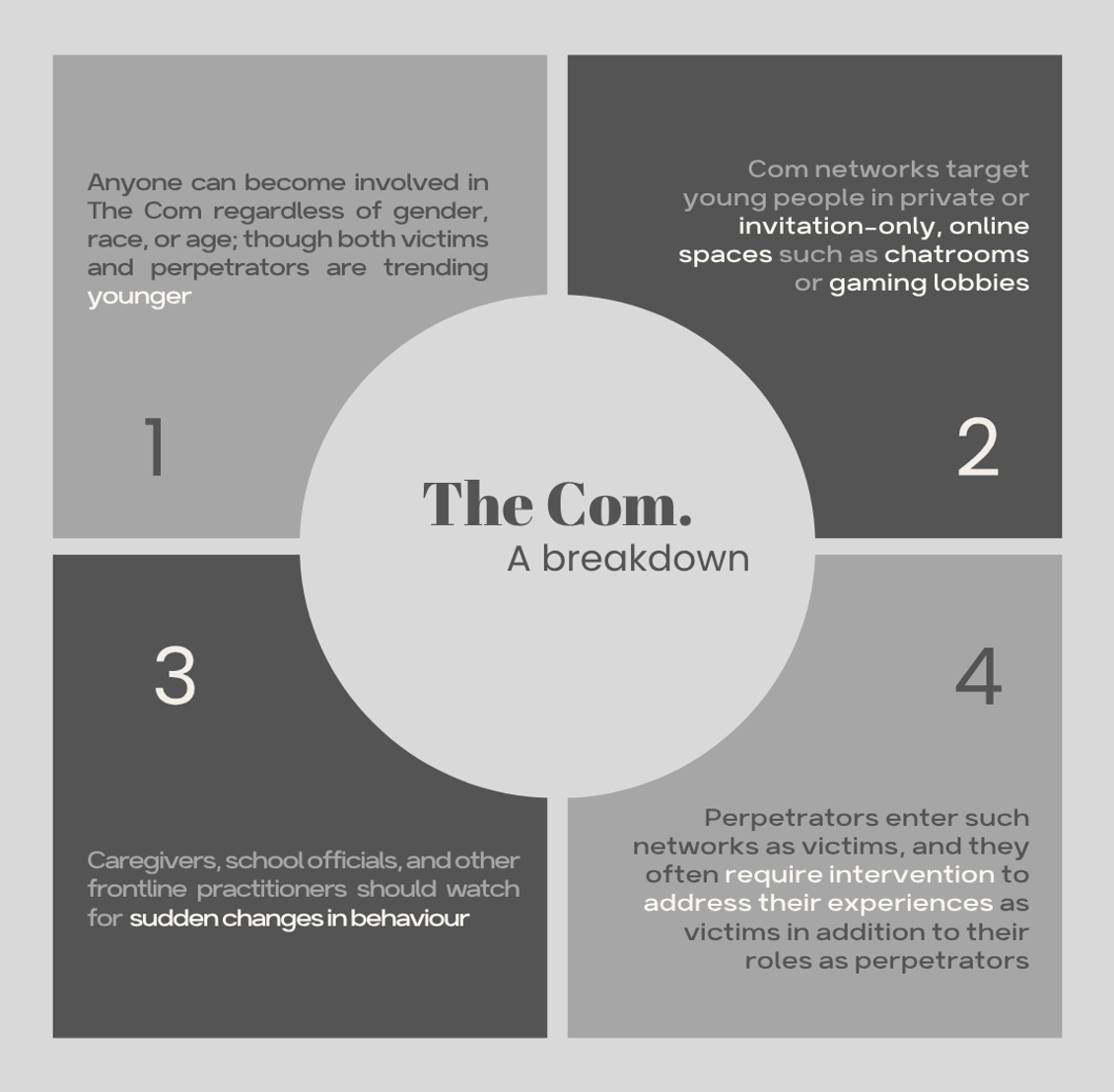
Infographic: Nurah Fisher
The Com – short for ‘community’ consists of private internet enclaves and splinter groups like 764 and TCC, looking to commit other forms of cybercrime and cyberterrorism. In a sample of 257 arrested perpetrators associated with The Com, 94.9% (244) were identified as male, and 5.1% (13) were identified as female — resulting in a 19:1 male-to-female ratio among cases where sex is known. The sample also highlighted a total of 5,375 individuals who have been victimised, with at least 22 fatalities, 1,747 victims of sadistic online extortion, 1,754 victims of “swatting”, 143 animals subjected to crushing, 1,633 victims of cybercrime, and 76 properties damaged; the number of victims severely outweighs the recorded perpetrators.
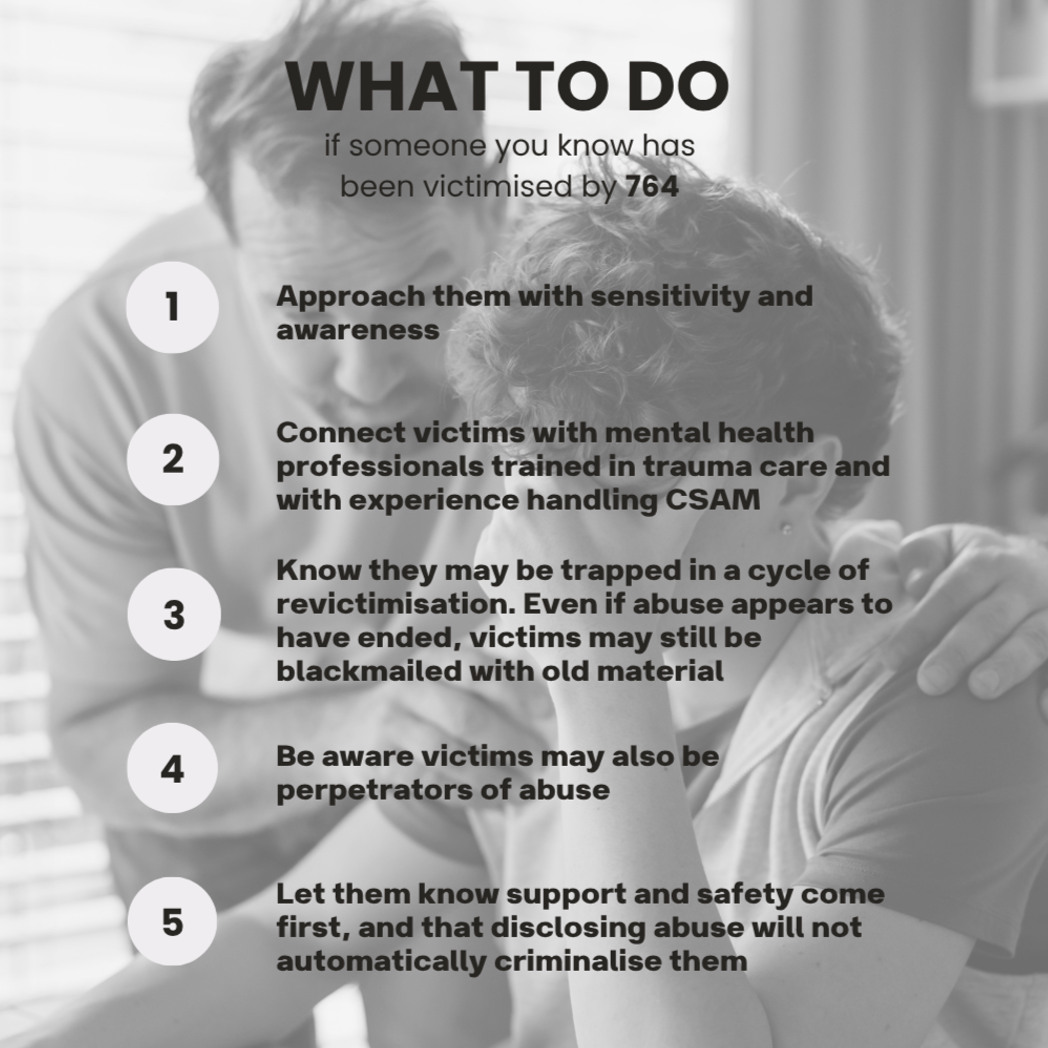
Infographic: Nurah Fisher
Image: Halfpoint
Members of 764 operate in unsuspecting corners of the internet and often in plain sight, on platforms like TikTok, Discord, Roblox, Snapchat, and X (formerly Twitter). One 764 leader boasted about their success rate on X, claiming that they found half of their victims on the platform where they say countless users who explicitly self-harm can be found — a prime target for members. This, however, is not an exhaustive list, as the hunting ground of 764 leaders extends to platforms including Twitch, Steam, Minecraft, Fortnite, Telegram, Reddit and Instagram.
The group’s online activity allows for an even more extensive reach, with cases being documented in the United States, Sweden, Singapore, Brazil, and Romania. The decentralised modus operandi of 764 also allows for the victimisation of a vast array of people. “Leaders” of 764 are senior coercive operators who establish groups, set norms, and direct or commission harm. These individuals seek to create agents of chaos who will then mobilise and carry out criminal, violent extremist, and terroristic acts on behalf of the community to increase the group’s status within the sadomasochistic milieu. In age, identified leaders range anywhere from 11 to 19 years old, whereas victims as young as 8 and as old as 82 have been identified.
It is worth noting that some leaders are also victims themselves. Individuals are often inculcated using coercive tactics and blackmail, leveraged by seasoned perpetrators of violence who manipulate targets into recruiting or abusing others. The Center for Naval Analyses reports that many perpetrators enter these networks as victims, where they begin as targets of grooming. These victims are then subjected to sextortion or other forms of pressure, resulting in the victimisation of new targets in order to comply with the demands of their own abusers.
Research by the University of Wisconsin suggests that during adolescence, the development of executive functions, which control cognitive function, takes place. These cognitive functions include self-control, abstraction, and temporal estimation and sequencing. Cognitive processes such as these provide children with the ability to create a plan, follow that plan through to completion, make corrections as needed and modify future behaviour based on the outcome. The research also indicated that during the preadolescent stage (9–12 years old), development of independent values and opinions, inconsistent abstract reasoning, and a need for privacy and to be an “insider” occurs. The Center for Combatting Terrorism (CTC) recorded the median age of perpetrators in The Com as being 19, the post-adolescence stage where there is “continued development of personal identity, morals, and values, with inconsistent execution.” The CTC notes, however, that this age data reflects the age of the offender at the time of their arrest; with the majority of these individuals being active within The Com for years, prior to their arrest.
Leaders of cells like 764 in The Com often create, distribute and utilise instruction manuals and guidebooks, such as the “Suicide Guide,” “Sextortion Handbook,” “Dox Guide,” “Kill Guide,” “Terror Guide,” and the “Evil Has No Limit” handbook.
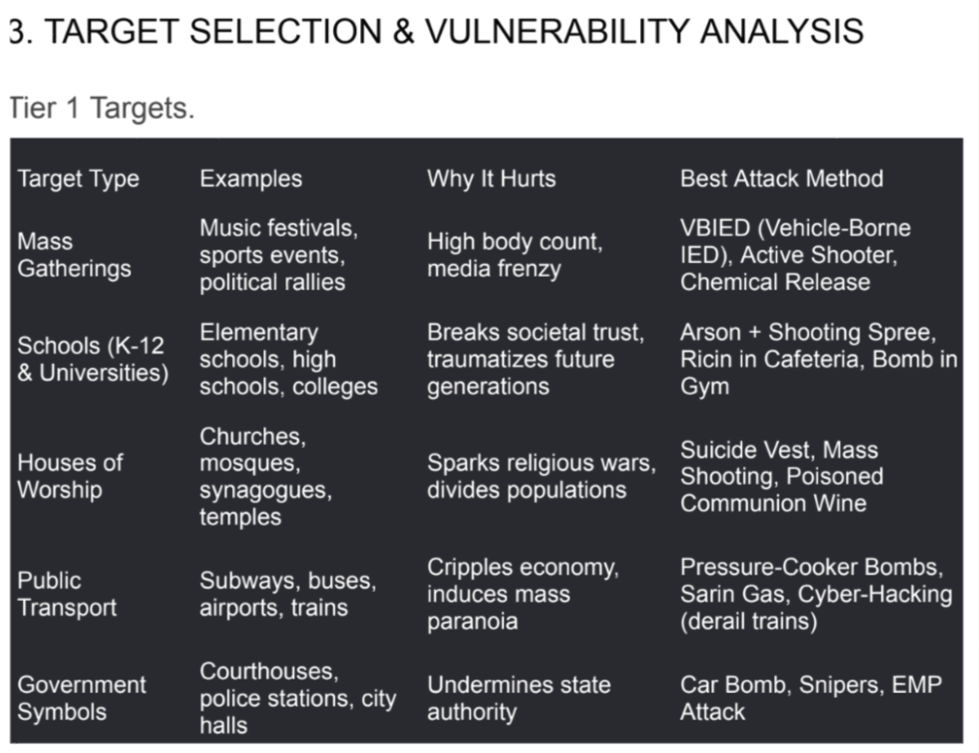
Information obtained from one handbook: Michael Corech
These harmful online resources have been instrumental in real-world abuse, swatting, harassment and assisted suicide of countless victims. Documented instances of abuse linked to 764 involve the stabbing of a homeless woman in Minnesota, attacks on the elderly in Sweden, and one teen expressing that she “obviously felt very cool” after succeeding at convincing her target to commit suicide while participating in a competition to see “who could do the worst thing.”
Guides and handbooks such as these assisted the ex-leader of one 764 target, who shared their experience. The individual stated that “in the server, there was CP, more gore edits and people telling me to hurt animals, I remember seeing a video of someone killing a rabbit and a MEGA file full of CP, along with a website that had a bunch too… I was 15." Following the abuse and as a result of the trauma, they would have panic attacks for years at the sight of other children alone.
Another target of 764 detailed the tactics employed by a leader called ‘Tomb’ who ran a server called h3ll. “In the beginning he seemed really nice and trustworthy, we started talking more, and things seemed normal… then he started sending messages that were threatening. He said that he would hurt people that I knew and, worse than that, he would pressure me into doing things that I didn’t feel comfortable doing, like self-harm and NSFW things,” they shared. The individual also highlighted how, “at one point he told me to cut his name on myself to “show I belonged to him’’,” a common tactic employed by perpetrators of and associated with 764. The survivor of Tomb relayed that to stop the abuse, they confided in their parents, and they helped them to report everything to the authorities, with Tomb’s account eventually being banned.
In a separate case, another survivor remarked that they were approached by someone who requested that they carve their name into their skin so that the abuser could use it as a profile picture. Proposed methods of intervention against instances of cyberterrorism among children offered by documentarian and researcher at the Human Rights Media Center, Funiwe Gxavu, include caregivers taking the lead in monitoring media consumption, as well as school roll-out programs which create awareness surrounding online threats.
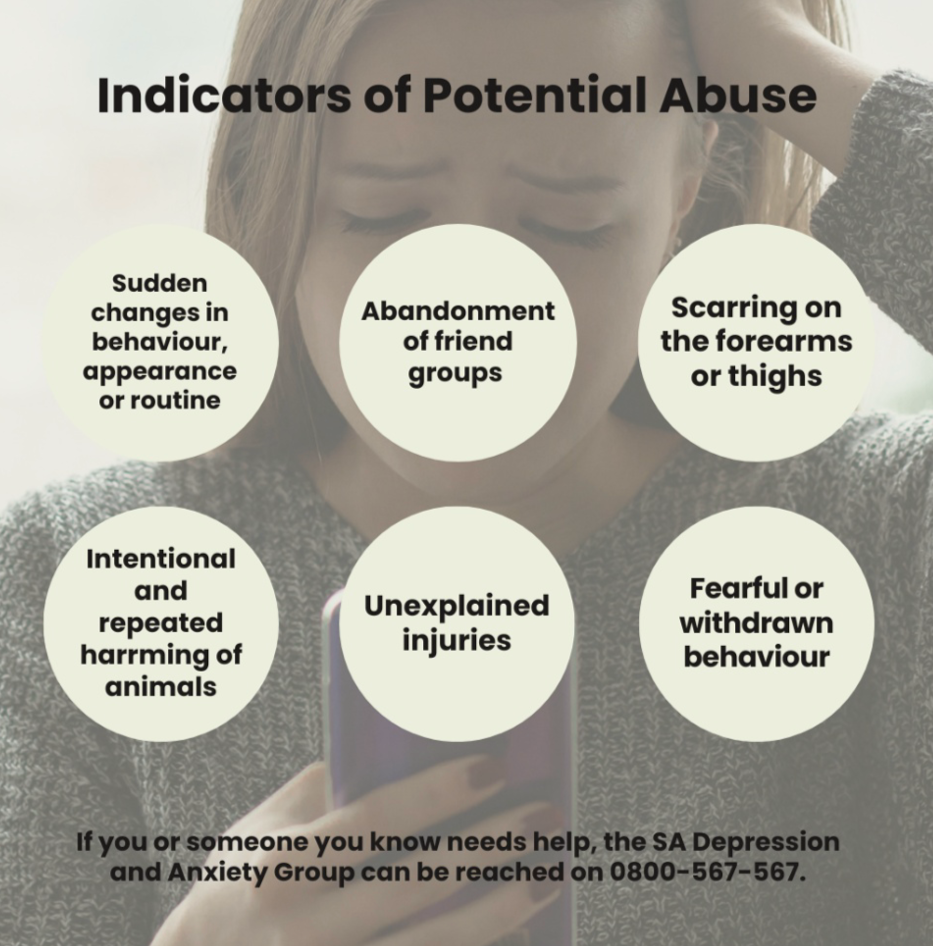
Infographic: Nurah Fisher
Image: Getty Images